Key Statistics Every Landscape Contractor Should Know in 2026
Running a profitable landscape contracting business in 2026 requires more than quality craftsmanship. It demands operational precision, accurate estimation, and the kind of client-ready deliverables that separate professional firms from the competition. The numbers behind the industry tell a revealing story—about where revenue is being won and lost, what clients expect, and how technology is shifting the playing field. Whether you’re a solo operator or managing a team of twenty, these seven statistics offer a data-driven look at what matters most. And for contractors evaluating landscape contractor software, the data makes a compelling case for why the right tools matter.
1. The U.S. Landscape Industry Is Worth Over $105 Billion
According to the National Association of Landscape Professionals, the landscape services industry generates more than $105 billion annually and employs over 1.3 million people across the country. This growth reflects rising demand for residential outdoor improvements, commercial property maintenance, and sustainable landscaping solutions.
A market of this scale creates opportunity—but also competition. Contractors who differentiate themselves through professional presentation and reliable execution are better positioned to capture a meaningful share.
2. 87% of Landscape Companies Report Labor as Their Top Challenge
The 2023 NALP workforce survey found that 87% of landscape businesses identified labor availability as their primary concern. With fewer experienced workers entering the trade, contractors must find ways to do more with existing teams.
Design software is one of the most direct solutions. A tool that cuts plan production time in half allows a single designer to handle twice the project volume—without adding staff.
3. Landscape Irrigation Accounts for 30% of U.S. Residential Water Use
The EPA estimates that outdoor irrigation represents roughly one-third of all residential water consumption in the United States, totaling approximately 9 billion gallons daily. As water restrictions tighten across drought-affected regions, clients and municipalities increasingly expect irrigation systems to be designed for efficiency from the start.
Contractors who use software with built-in hydraulic calculations and coverage verification can demonstrate this efficiency clearly—both in proposals and in approved permit documentation.
4. Inaccurate Bids Erode Margins by Up to 6%
Research from the Construction Financial Management Association indicates that estimation errors can reduce project margins by as much as 6%. For a contractor bidding $150,000 in projects per month, that’s $9,000 in potential monthly losses—directly attributable to preventable mistakes.
Automated takeoffs and material quantity tools built into design software remove the manual calculations where most estimation errors occur.
5. Contractors Using CAD Tools Report Saving Hours Per Design
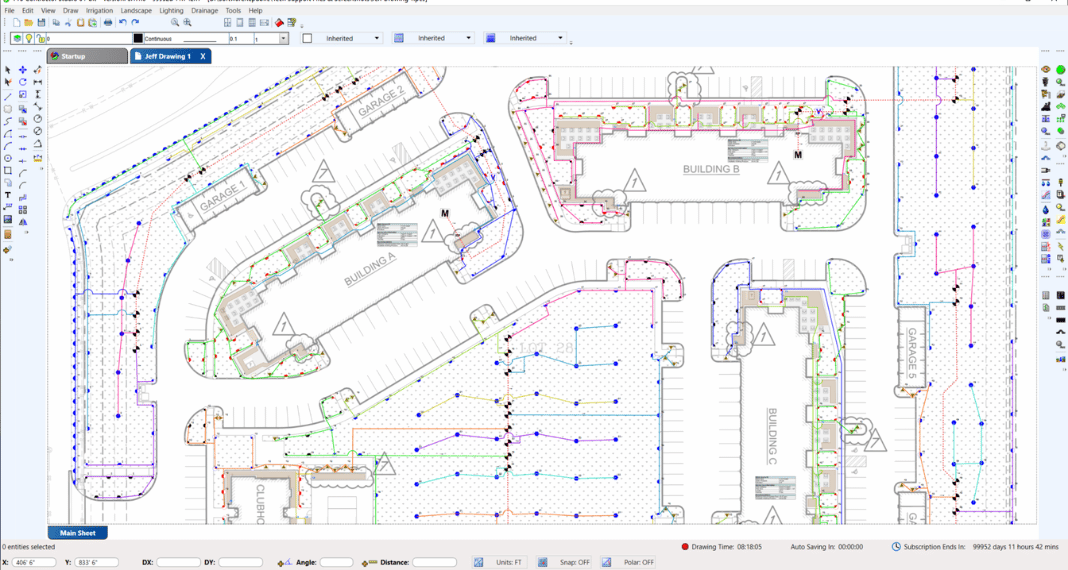
Pro Contractor Studio users report saving multiple hours per design compared to manual drafting methods. Over an active season of 100+ projects, those hours add up to weeks of recovered capacity—time that can be redirected toward client acquisition, crew management, or additional projects.
The platform has facilitated over 250,000 plans since its introduction, with more than 10,000 contractors currently using it across residential, commercial, and specialty projects.
6. Professional Proposals Increase Close Rates
A study from Proposify found that contractors who present structured, visually clear proposals close deals at a significantly higher rate than those using informal formats. In landscape contracting, this means that the quality of a printed plan or client-ready drawing directly influences whether a prospect signs a contract.
Software that produces clean, branded, printable PDFs from the same program used to do the technical design work gives contractors a straight path from design to proposal.
7. 65% of Contractors Now Use Some Form of Digital Project Tool
Software Advice’s 2023 contracting technology survey found that 65% of small-to-mid-size contracting businesses use digital tools for project design or management. Among landscape-specific contractors, CAD adoption still lags—which means early adopters enjoy a meaningful competitive advantage.
Turning Data Into Action
Statistics are only useful when they inform decisions. Taken together, these numbers point clearly toward one conclusion: the contractors investing in professional design tools are building more efficient, more competitive, and more profitable businesses. The window for early adoption advantage won’t stay open indefinitely.